
Hey all!
We're back with another guide, and this time we're focusing on something crucial: understanding your game before you start your marketing journey. Whether you're a solo dev or part of a small indie team, this groundwork will serve as a baseline for all of your marketing efforts, keeping you focused and on track. This will also help you if you’re looking to pitch your game to publishers or apply for funding from a government body. Let's dive in!
Define Your Game’s Identity
Before you start any market analysis, take time to clearly define your game's core identity. This means articulating what it's about, what makes it stand out, and what experience players will get from it. As the devs, you probably already have a sense of these things, but putting them into clear, concrete terms will make everything else easier!
SWOT
Every single game has its own SWOT (Strengths, Weaknesses, Opportunities, and Threats). Strengths and weaknesses are internal factors; they come from your game itself. For example, if you're developing a roguelike, your strengths might be the banger music and an addictive gameplay loop. Your weakness could be the lack of customizable character loadouts, which might make some runs feel repetitive.
Opportunities and threats, on the other hand, are external factors. These come from the market and the environment around your game, not from the game itself. Here's the tricky part: the same factor can be both an opportunity and a threat.
For example, roguelikes are incredibly popular and have been for years. The opportunity? There's an established audience (and possibly content creators) who only play games in this genre, making it easier to reach potential players. The threat? The market is saturated. With so many roguelikes out there, standing out becomes harder, and it might take more effort to get under their radar.
Mapping out your SWOT early helps you set realistic expectations for your marketing efforts. By understanding these factors upfront, you'll know where to focus your energy and how to position your game before you put it out into the world, which brings us to the next part:
USP and Positioning
Unique Selling Points
Like SWOT, every game has its own Unique Selling Points (USP in the fancy marketing term). Your game's strengths usually double as your USPs, but there’s a key difference: a USP is specifically what makes your game stand out from the competition.
For example, in your roguelike game, players can switch between characters mid-combat for powerful combo attacks. The transition is seamless, and it's something your team is genuinely proud of. Or maybe your core gameplay revolves around deception, where everything in the game misleads the player character, so players can only trust what they see with their own eyes.
Another example: in Voidtrain, developed by our client HypeTrain Digital, players can fully customize their trains, which serve as their mobile base to protect them while venturing into the dangerous Void. This customizable train concept became a key USP that differentiated it from other survival games.
Take your time listing out the features you want to highlight in your marketing! This exercise will help you identify your game's core strengths and figure out how to present them in a way that resonates with your audience, which brings us to our next point: positioning.
Positioning
This is where it gets a bit tricky. Now that you've identified your USPs, it's time to position your game in the market among your competitors so you can find the right audience. There are ways to approach this, but I usually go with a visual positioning map using Miro. For example:
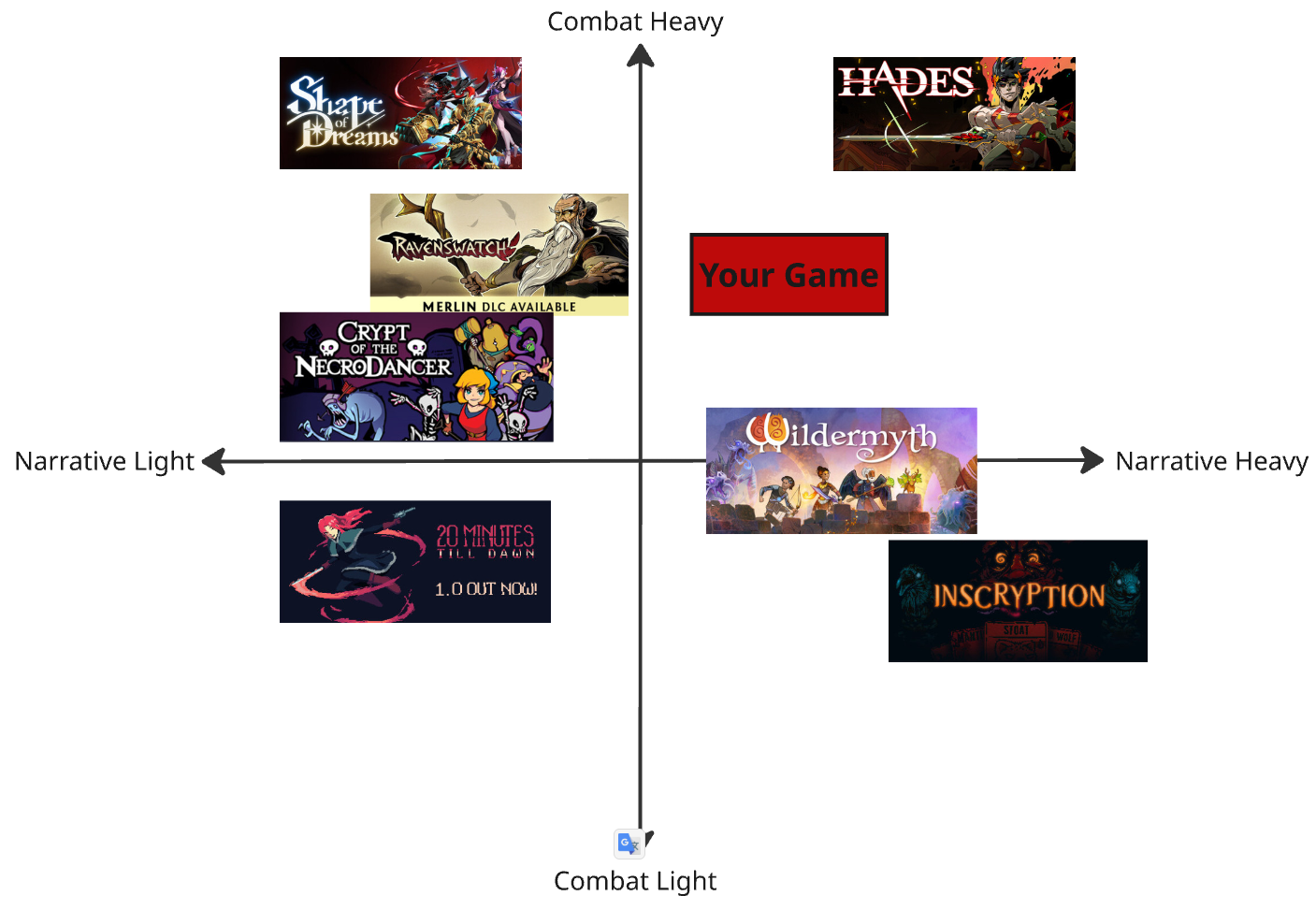
Disclaimer: This is just an example to show how a positioning map works. You might disagree with where I've placed these games, and that's totally fine!
In the example above, I've mapped out several roguelike games based on two key dimensions: how combat-heavy they are and how narrative-rich they are. Let's say you want your roguelike game to have just enough storyline with fleshed-out combat mechanics. In this case, you'd position yourself in the upper right quadrant, closer to Hades and the Y-axis, but slightly further away from Wildermyth, which is relatively light on combat mechanics.
This framework is highly customizable based on what matters for your genre. If you're making a shooter, your axes could be weapon variety and gameplay loop complexity. For an RPG, you might use art style (realistic vs. stylized) and world structure (linear vs. open-world). The key is choosing key dimensions that help differentiate games in your space to make it easier for you to determine your audience, which brings us to the next part:
Know Your Target Audience
Competitors
One of the most crucial steps in your marketing analysis: studying your competitors. Once you've positioned your game on the map, the titles you put there can be considered as your direct competitors. Your competitors are typically similar in scope and genre, and it's worth studying both successful and unsuccessful titles. Either way, there's something valuable to learn from each one!
Start by listing out the similarities between your game and your competitors. For example, let's say your roguelike shares some similarities with Hades: both have rich narratives and tons of build variety for players to experiment with. But here's where you differ: your game has co-op, while Hades is strictly single-player. Compared to Wildermyth, you both have turn-based combat systems, but your game doesn't have any choices and consequences the way Wildermyth does.
Do this exercise with at least 5 competitor titles to get a clear picture of where your game fits. By identifying what you share with your competitors and where you differ, you'll naturally start to understand your target audience and niche. It's also worth checking out how these games present themselves on social media, because you can learn a lot from what type of content resonates (or doesn't) with their audience!
Release Platforms
This might seem obvious, but understanding your audience also means releasing your game on the right platform. Most indie games launch on Steam first, with console ports coming later. Each platform comes with its own audience, requirements, and marketing opportunities, and some might be a bit harder to navigate than the others. Steam might be your primary focus, but if the team can port to consoles, that opens up different audiences and promotional channels. One thing to keep in mind: more platforms mean more complexity in both development and marketing, so make sure you have enough resources if you decide to publish your game on more than one platform!
Establish Your Marketing Pillars
Game SEO
In social media and online presence, SEO (Search Engine Optimization) is crucial for game discoverability. When someone searches for your game's title or relevant keywords, you want your official content to show up first, not anything unrelated to your game or something else entirely. This means being strategic about choosing your game’s keywords and how you describe it across your social media platforms so that your game gets picked up.
The way to determine your SEO keywords is by looking at what your game offers and what niche it belongs to. You can also check out the social media accounts of similar games for inspiration on what keywords they're using! For example, let's say you're making a roguelike with a Lovecraftian horror theme. Your keywords (and hashtags, sometimes) might include: Roguelike, Lovecraftian, Horror, Cosmic Horror, Horror Adventure, Action Horror, and so on. You can also use a mix of broad genre terms and specific descriptors that capture the uniqueness of your game!
Marketing Pillars
We've finally reached the final step: crafting your marketing pillars! Think of this as bringing everything above into focused messages that will guide all your marketing efforts. Marketing pillars are the 3-5 core statements that define what your game is about and what makes it stand out from competitors. If you’re feeling stuck, you can return to the USPs and go from there!
For example, let's say your game has a rich narrative surrounding the main character that you want to highlight. Your marketing pillar for this could be something like "Dive deep into an alternate dimension where you can only trust your eyes." This messaging hints at gameplay where what you hear might deceive you, creating intrigue without spelling everything out, and has the potential to hook your audience immediately!
Once you have your marketing pillars, you can use one or combine two of them to create copywriting for social media, your Steam page, press releases, and more. It's recommended to have at least 3-4 pillars, so you always have something to draw from when you're stuck or need fresh angles. This approach helps you cover different aspects of your game while staying true to its core identity!
Hope this guide helps! If you need support with your game's market analysis or any of the topics we covered here, we're always open for a consultation. Feel free to reach out, and we'll see you in the next blog!